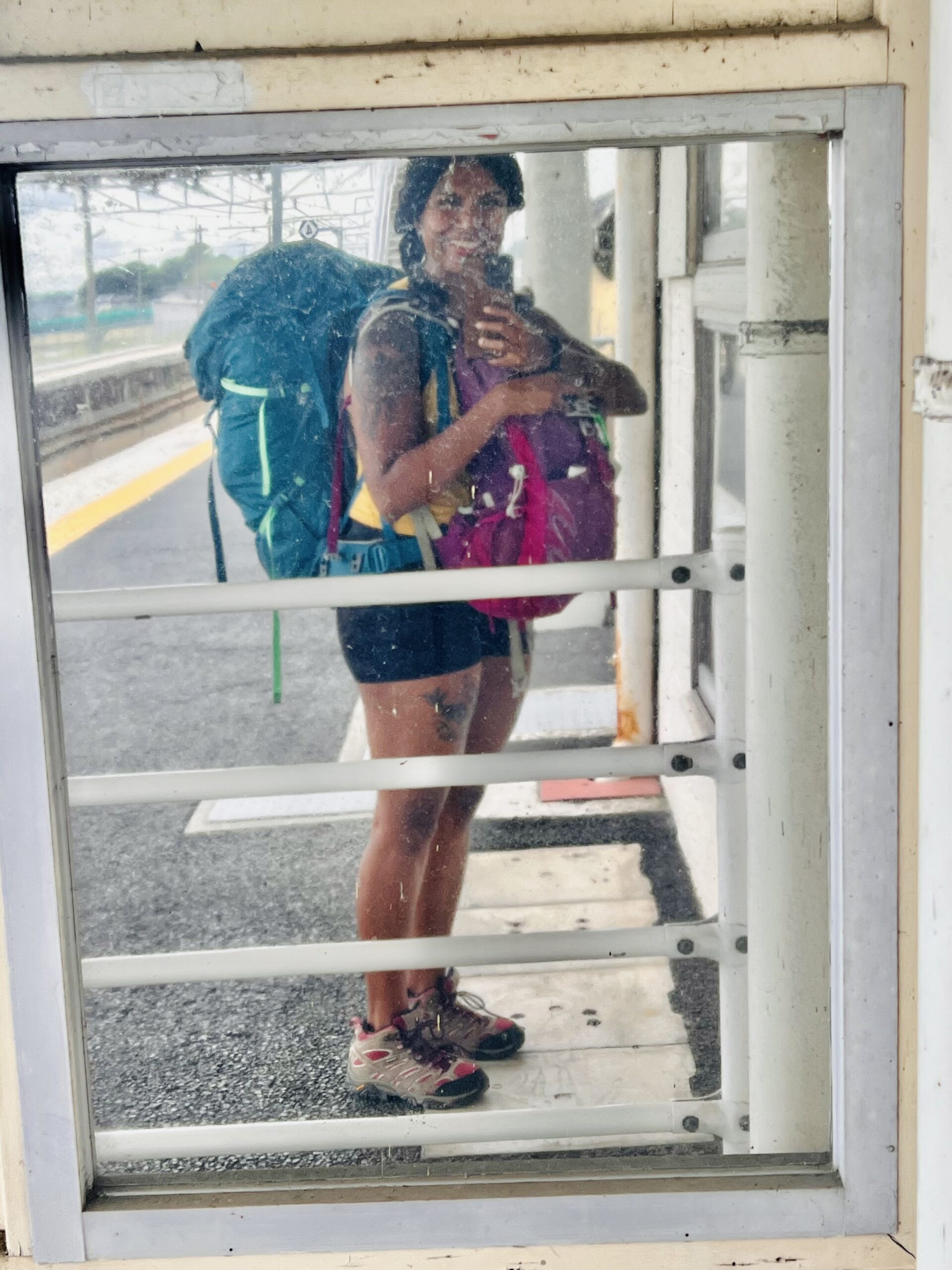
Would you buy a train ticket when there is no one checking?
In 2023, I visited Hayashima, a small village in Japan’s Okayama prefecture. Tired of big cities, I wanted a taste of the quiet countryside, and Hayashima delivered. Descending the stairs of the train station, I found the entire landscape enveloped in unending rice fields—a sea of lush green.
The guesthouse I checked into was a traditional Japanese house with tatami floors and a zen garden. My host handed me a hand-drawn paper map to explore the neighborhood, a quiet loop that took about thirty minutes to circle around.
The next day, I set out to visit Naoshima island. Although technically an hour away, it was a small expedition to get to: first a train from Hayashima to Okayama, then a bus from JR Okayama Station to Uno Port, and from there a ferry to Honmura Port on Naoshima. I was eager for the adventure, particularly because this quiet island in the Seto Inland Sea houses some of the most beautiful contemporary art museums in Japan, if not the world. It was intriguing to me that an island in the middle of nowhere could hold such extraordinary art.
The Chichu Art Museum exceeded every expectation. Designed by the renowned Japanese architect Tadao Ando, this vast subterranean museum held only three exhibits: Claude Monet, James Turrell, and Walter De Maria. The juxtaposition of the calmness in Monet’s water lilies, the manipulation of light and shadow in Turrell’s light installations, and the simplicity and placement of De Maria’s metallic spheres combined with Ando’s geometric design to pull natural light straight into the earth. It was a magical, immersive experience—one that caused my heart to race, goosebumps to rise, and brought tears to my eyes, deeply stirring emotions within me that I couldn’t completely comprehend in the moment.
Yet, a quieter moment from that morning lingered with me just as strongly.
Before catching my train, after a quick breakfast of konbini coffee and onigiri, I had walked over to Hayashima station. I bought my ticket and headed toward the platform. Being a small town, there was only one walkway leading to the two platforms on either side of the tracks, connected by an overpass. As I advanced toward the gate, I was surprised to see that there were no turnstiles, no automated IC card readers, and no station master in sight. It was simply a manual gate that you could push open.
Yet, as I waited on the platform, I watched passenger after passenger patiently buy their ticket from the machine, push through the gate, and walk to the platform. I initially assumed the station master was simply away on a break. But when I returned that evening, the scene repeated itself: unmonitored commuters calmly lined up to drop their used tickets into a small collection basket by the exit.
The following morning, on my way to explore Okayama city, it was the exact same story. No station master, yet schoolchildren, commuters, and elderly locals all stopped at the machine, bought a ticket, and pushed through the empty gate.
That evening, when I returned to the guesthouse, I asked my host about the missing station master.
Surprised by my question, he looked at me innocently and asked, “What station master?”
“You know, the one who is supposed to collect our tickets,” I replied.
He let out a warm, gentle laugh. “We don’t have one right now.”
“Isn’t there a problem with people not buying tickets?” I asked.
His expression turned genuinely bemused, as if the concept itself was foreign. “No, Mia-san,” he said softly. “We always buy a ticket. It’s just what we do.”
His earnest answer felt like a delicate lesson in trust. That night, as I lay on my neatly laid out futon on the tatami floor, his words stayed with me. In the countryside of Japan, you not only learn to be a decent person while people are looking, but more importantly, life here teaches you to ask a simple question every single day: “Who are you when no one is watching?”
The next morning, after a slow coffee and a few chapters of my book, I packed my bags, thanked my host for a wonderful stay, and walked back to the train station. I bought my ticket with a sense of pride, stood in line to push open the metal gate, and boarded the train to Kobe with a smile on my face.