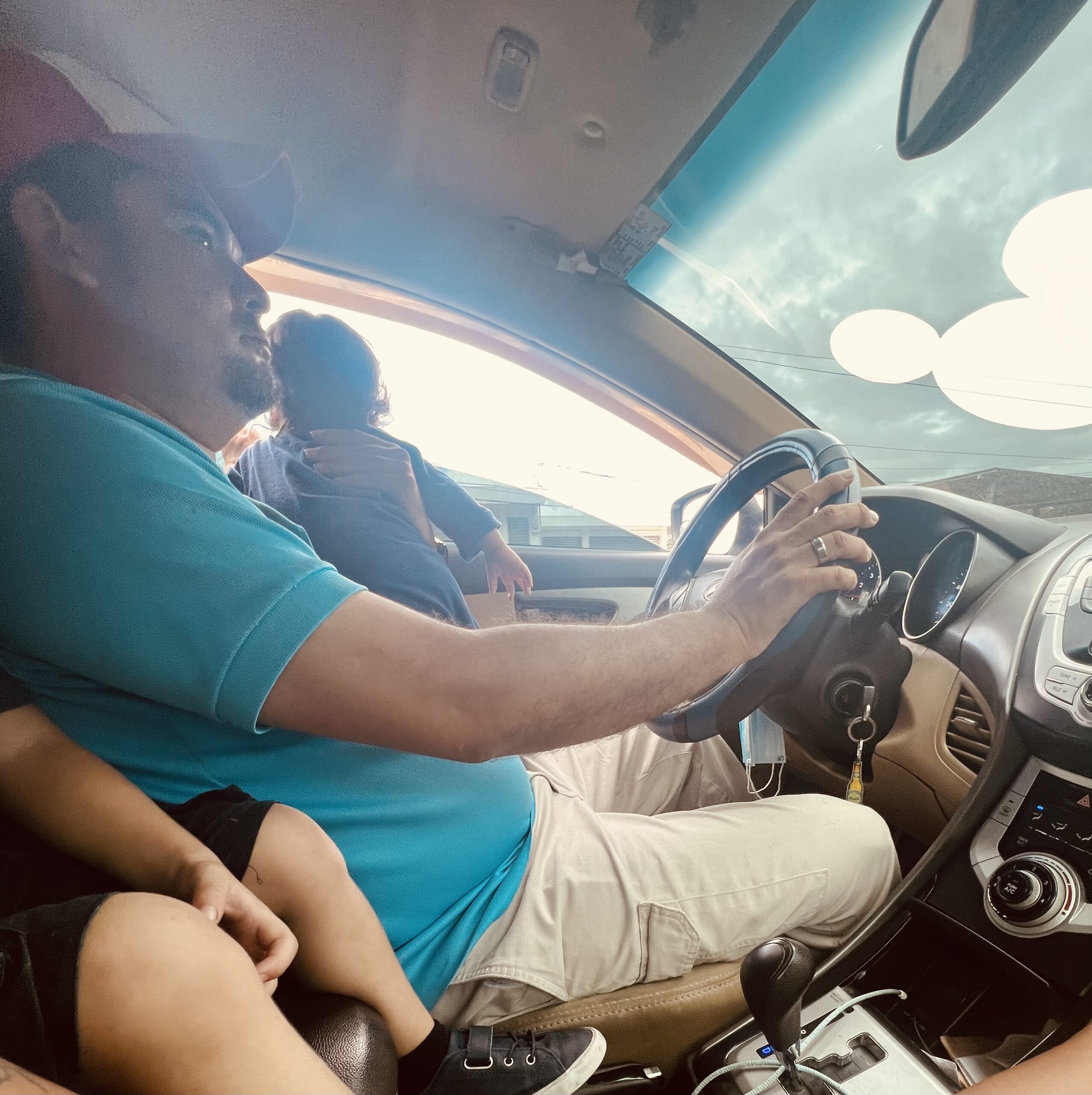
It was just me and the driver now. We barely spoke, the language barrier was too much, and about ten minutes later, I noticed we’d left the main route. I gave it a few more minutes before saying anything, but he was on the phone, talking fast, and then swerved off the highway onto a narrow side street. When I asked why, he just gestured for me to wait and kept talking animatedly on his phone.
That’s when I decided there was a real chance I was being kidnapped.
In November 2019, I traveled to Honduras. After a few days near Lago Yojoa, north of Tegucigalpa, I took a bus to San Pedro Sula, planning to catch another bus from there to La Ceiba. The goal was to hike Pico Bonita National Park the next day, then catch an afternoon ferry to the island of Utila.
When I got to San Pedro Sula, I found out no buses were leaving that day — a festival procession had shut down the whole terminal. Staying overnight wasn’t really an option. I was on a short holiday with only the next morning to early afternoon free for the hike, and San Pedro Sula wasn’t a city I wanted to spend the night in. It had a reputation as one of the murder capitals of the world at the time, and after confirming with a few people that the buses truly weren’t running, I decided to find a taxi instead.
At the taxi stand, the drivers quoted me 250 USD to San Pedro Sula to La Ceiba, clearly taking advantage of the bus strike and the fact that I was a tourist who barely spoke Spanish. I walked away and found a random taxi nearby with three passengers already inside, waiting on a fourth. I asked the driver if he could take me to La Ceiba. He said 200 USD, since it was far and his other passengers were only going as far as Mezapa, an hour away. I countered: 100 USD to get me to my hostel, and he could pick up as many passengers as he wanted after that. He thought about it, hesitant, and finally agreed.
I got in without a second thought and soon realized I had no internet connection, only a downloaded map, and was blindly trusting a stranger. If anything went wrong, I had no way to call anyone.
We reached Mezapa and the three women got out. It was just him and me now — this was the moment I described at the start, the swerve off the highway into that narrow side street.
I was running through worst-case scenarios in my head when the taxi stopped. A woman in her late twenties climbed in, a two-year-old on one hand and a nine-month-old strapped to her chest. The relief hit me before I even understood what was happening — whatever this was, it was better than what I’d been imagining.
The driver turned around and pointed at them, then at himself, trying to bridge the gap between us with the only words he had: “Esposa. Hijos.” Wife. Kids. I smiled so wide it barely covered what I was actually feeling underneath it.
Piecing it together took her broken English, my downloaded map, and a lot of pointing, but eventually I understood. Rain was coming hard that afternoon, and the procession traffic meant he wouldn’t make it back to San Pedro Sula safely that night, so somewhere in the last twenty minutes, mid-drive, he’d called his wife and pitched her on a plan. A family trip to La Ceiba, since he was already headed there with me anyway, and tomorrow was a Sunday. They’d stay the night, picnic in the national park in the morning, enjoy the nature, and drive home the next evening. She’d packed a bag with a night’s clothes and food for dinner and breakfast in the time it took him to swing by and get her.
The next five hours were some of the best I’ve spent in a car in my life. I watched a Latina family function in real time, the quiet division of labor, her keeping the baby fed and settled, him driving carefully through rain that had slowed us down by two extra hours. Their two-year-old planted himself on the console between us, narrating the road in a language I didn’t speak, like he owned it. At some point, without asking, she handed me a plate of rice and chicken from the food she’d packed for her own family.
By the time we reached La Ceiba, it was past 7:30 pm, fully dark. He didn’t just drop me off at the center, he asked around, then walked me straight to my hostel’s door, because he didn’t want me searching for it alone at night.
I thanked them, paid him, and watched them drive off toward their own version of a weekend getaway — one that had started as a favor to a stranger.
The city everyone had warned me about turned out to have nothing on the family who drove me out of it. I still think about that ride more than almost anything else from that trip. Most people, in most places in this world, are kind. And what you put out into the world tends to circle back, often from directions you didn’t see coming, but in abundance. I won’t pretend the other outcome wasn’t possible. It was. But I’m not willing to trade a life this full of strangers who become stories, roads that go sideways and turn out fine, and a world that keeps proving itself gentler than its reputation just because of that one small possibility and that one small fear that it may go wrong.
But maybe next time, I will get a working SIM card when I travel unhinged in foreign countries. 😉