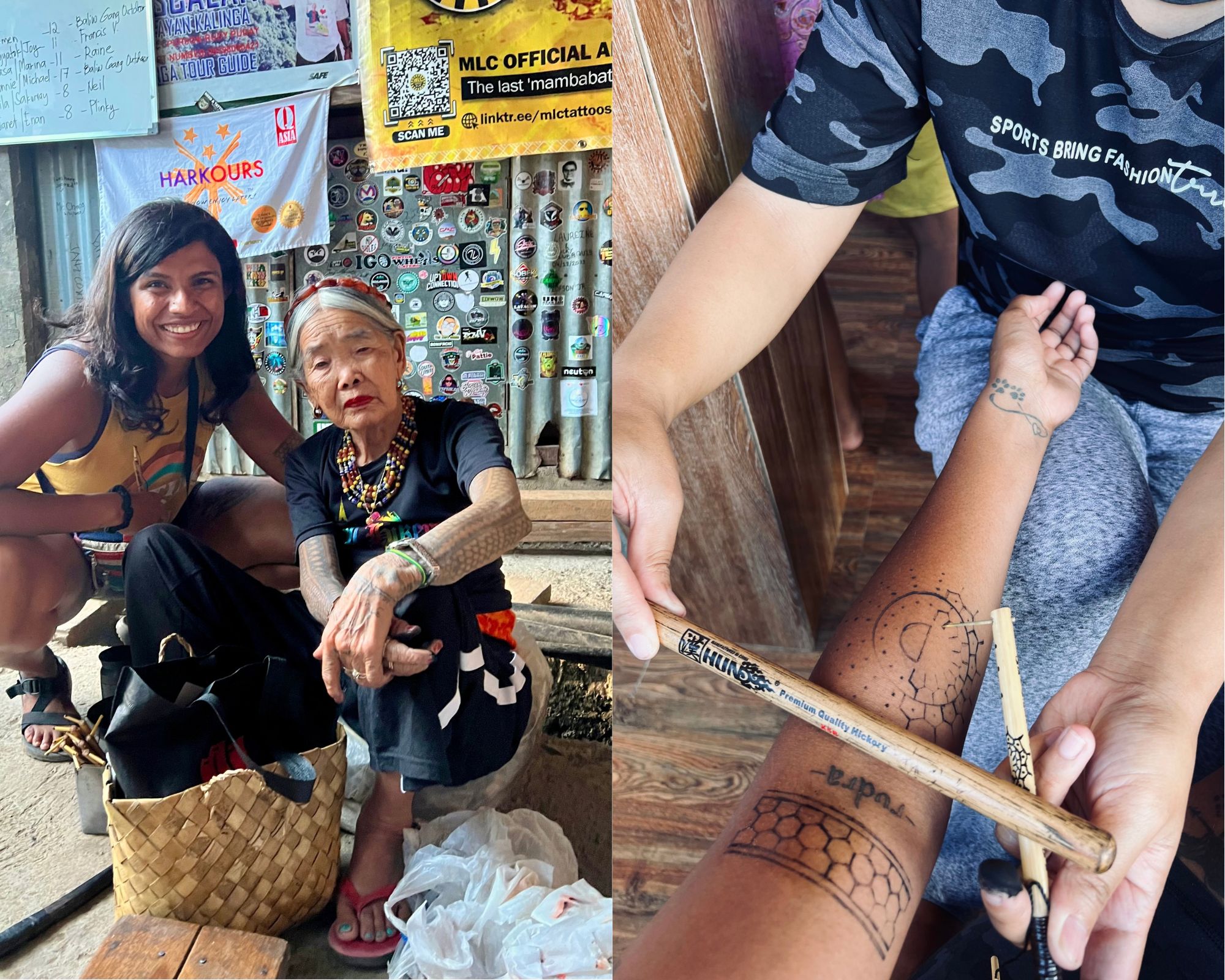
(Suha, in Tagalog, means pomelo fruit)
Hidden in a small village called Buscalan, in the mountains of northern Philippines, is a community of women who take care of each other with the love and passion of one giant family.
In July 2023, I visited Buscalan, tucked away in the Kalinga province roughly 430 kilometers north of Manila. I took a minivan from Manila to Sagada, stayed the night there, did a hike through the Blue Soil Hills, and woke up early the next morning to catch the sunrise over the Marlborough Hills. At first, the ridge was blanketed in thick fog. But for five fleeting minutes, the clouds cleared, giving me a peek at a stunning sight: a sea of clouds floating over a valley of lush green hills. After a quick breakfast, I set off for Buscalan. This little village was one of the main reasons I came to the Philippines, because it is home to the tattoo legend, Apo Whang-Od.
Apo, now 109 years young, is the last living master from the older generation of Kalinga tattoo artists. She learned the ancient batok art from her father when she was just fifteen. In those days, tattooing was practiced only by men, but thanks to her perseverance and natural skill, her father chose to teach her. Over the years, as her contemporaries passed on, she became the sole guardian of the craft. Eventually, she passed the knowledge down to her grandnieces, and today in the village, women are the primary keepers and practitioners of this sacred art. Apo changed the course of history for her people, giving these women an art form to inherit, genuine confidence, and a sustainable livelihood. She even became the oldest person to be featured on the cover of Vogue magazine, putting tiny Buscalan on the global map. She created a thriving micro-economy for the entire village: women work as tattoo artists, while the men run homestays, small eateries, and transport services for travelers coming to get inked.
Apart from the signature three dots from Apo, her signature representing the three words of her name, Whang-od Oggay, I decided to get two more designs. I chose the symbol for a half-sun and half-moon, which represents the cycle of life, and a snakeskin band, symbolic of protection. A group of six women approached me, and once we agreed on the design and price, they got straight to work.
It took them four hours in total. I watched them stencil the pattern onto my skin using stems of leaves and dried twigs, mix the ink using charcoal powder from burnt pinecones, and create the tattoo tool using a sharp thorn from a pomelo (suha) tree tied securely to a wooden stick, a precious souvenir I still carry with me today. Four different women took turns tattooing me. When the piece was finally done, I reached out to pay the woman who finished it.
She shook her head and pointed to another woman sitting nearby, telling me I had to pay her instead.
“Wait, isn’t this for all of you?” I protested innocently.
“Yes, it’s for all of us,” she smiled, and then explained how their system worked.
Six to seven female artists come together to form a small collective. Whatever each of them earns during the day goes into one common pouch. At sunset, the money is divided equally among everyone, regardless of who worked the most hours or who had more experience. Because of this system, if someone falls sick, she still gets paid. If someone is pregnant, she continues to receive her share through delivery and postpartum recovery. And if one of them has to stay home or cut her day short to care for a sick child or husband, she can still afford to put food on the table. Through this quiet agreement, they built an unbreakable sisterhood where no one gets left behind.
That evening, as I walked through the village pathways, I saw groups of neighbors sharing coffee and snacks, younger people helping elderly villagers with chores around their homes, and everyone living and celebrating life together like one big extended family. They might never eat a Michelin meal, fly to another country, or watch a movie in an IMAX theater, but what they have is infinitely more valuable, rare, and grounding. They have deep love in their lives, a community that watches over one another, and happiness that removed away the loneliness epidemic that is spreading fast in this modern world.