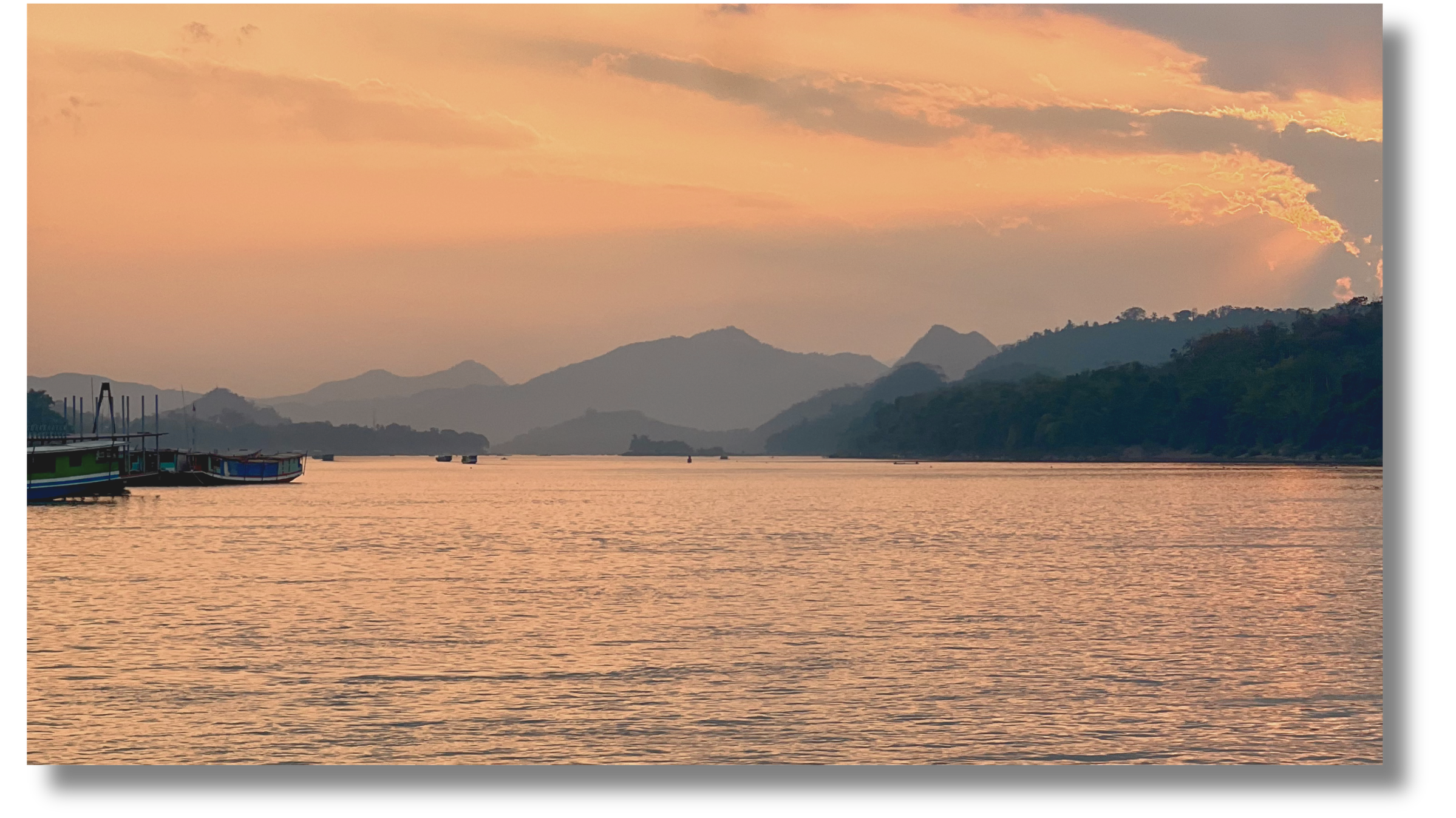
John is an eighty-five-year-old retired Norwegian diplomat who, despite his unassuming name, is one of the most fascinating men I’ve ever met. We crossed paths on a long, wooden boat leisurely floating from Thailand into Laos. While most travelers now opt for the four-hour high-speed train, John chose the two-day slow seduction of the Mekong river from the border village of Huay Xai to the cultural capital of Luang Prabang.
He wasn’t traveling alone. He was accompanied by a vibrant Korean woman in her sixties. They shared a deep platonic friendship and a mutual hunger for the road. Both were in fulfilling, loving marriages; their spouses simply didn’t share their nomadic spirit. “I have to explain at every guesthouse that we need separate beds,” John told me, laughing. “They always assume we’re a couple.” At eighty-five, this was John’s only complaint—not back pain, not the heat, and certainly not a fear of the end.
“And where are you from?” he asked as I settled onto a heavy sandbag in the front of the boat.
“India,” I replied.
From there, the conversation unfolded like the river itself. We talked about the friction and beauty of cultural differences, the sensory joy of new cuisines, and the fundamental ways Asia breathes differently than the West. He was a wealth of knowledge, but he carried it lightly, with a sharp wit honed by years of living in different countries across the globe for the Norwegian embassy.
Eventually, I asked him, “What is one travel experience you’ll never forget?”
John chuckled, leaning back as he launched into a story from a world that no longer exists.
Back in graduate school, John and a Japanese colleague found a way to see the world for free. As broke students, the opportunity was a miracle: a company was exporting minks from Norway to Hokkaido, Japan. Their job was to care for the animals—feeding them and cleaning their cages mid-flight. In exchange, they received a private plane ride and all their meals.
When they landed in Hokkaido, young John was stoked to be in Japan for the first time. After carefully completing his job, John and his colleague happily filled their hungry stomachs with sushi and sake. John’s colleague said goodbye to him to take a short vacation to visit his family somewhere in northern Japan. The company that they were traveling with asked John if there was anyone in Japan he would like to visit. John remembered a pen pal he had exchanged letters with since his early teens. Thanks to the efficiency of Japanese records, he managed to find her phone number in Tokyo. Without hesitation, he dialed.
To his utter surprise, the woman on the other end didn’t speak a single word of English—despite years of sending him letters written in flawless, elegant prose. John didn’t speak Japanese. The conversation was brief, a polite collision of two people who had known each other for years on paper but were strangers in the air. “I’m sorry to disturb you, I hope you’re well,” John managed before hanging up. After enjoying some more time in Hokkaido visiting some beautiful sites, he was on his way back to Norway.
A couple of months later, a neatly written letter arrived in Norway from Tokyo. His pen pal asked if the phone call from Hokkaido had been real, or if she had dreamt it. Laughing, John replied to her letter that he did, in fact, call her and that he didn’t realize that she didn’t speak English. And thus, restarted a pen friendship after all those years. After a few letters, the tone shifted. Confused, John showed the latest letter to his Japanese colleague, who burst into laughter. He explained that the pen pal was no longer seeking friendship; she was expressing a deeper romantic longing for him. Unfortunately, John didn’t feel the same, and just like that, the letters stopped.
As John finished his story, the sun began to dip, casting a liquid gold glow over the Mekong. I sat in silence, wondering about that girl in Tokyo who had fallen for a handsome Norwegian boy sixty years ago. I imagined that she moved on, perhaps to have a sweet little family of her own. As she grew older, I pictured that she left the busy streets of Tokyo to find a quiet life in the countryside, unaware that her old heartbreak was being recounted on a river boat half a world away.
As we finally docked in Luang Prabang, John held my hand. “I hope I get to see you again, Mia.” I gave him a long hug and stepped onto the shore, carrying my backpack and his stories into the heart of Laos.
I hope to see you again, John. If not, I think it’s time I finally wrote you a letter.